Still Serving: Staying Relevant Through Community Service
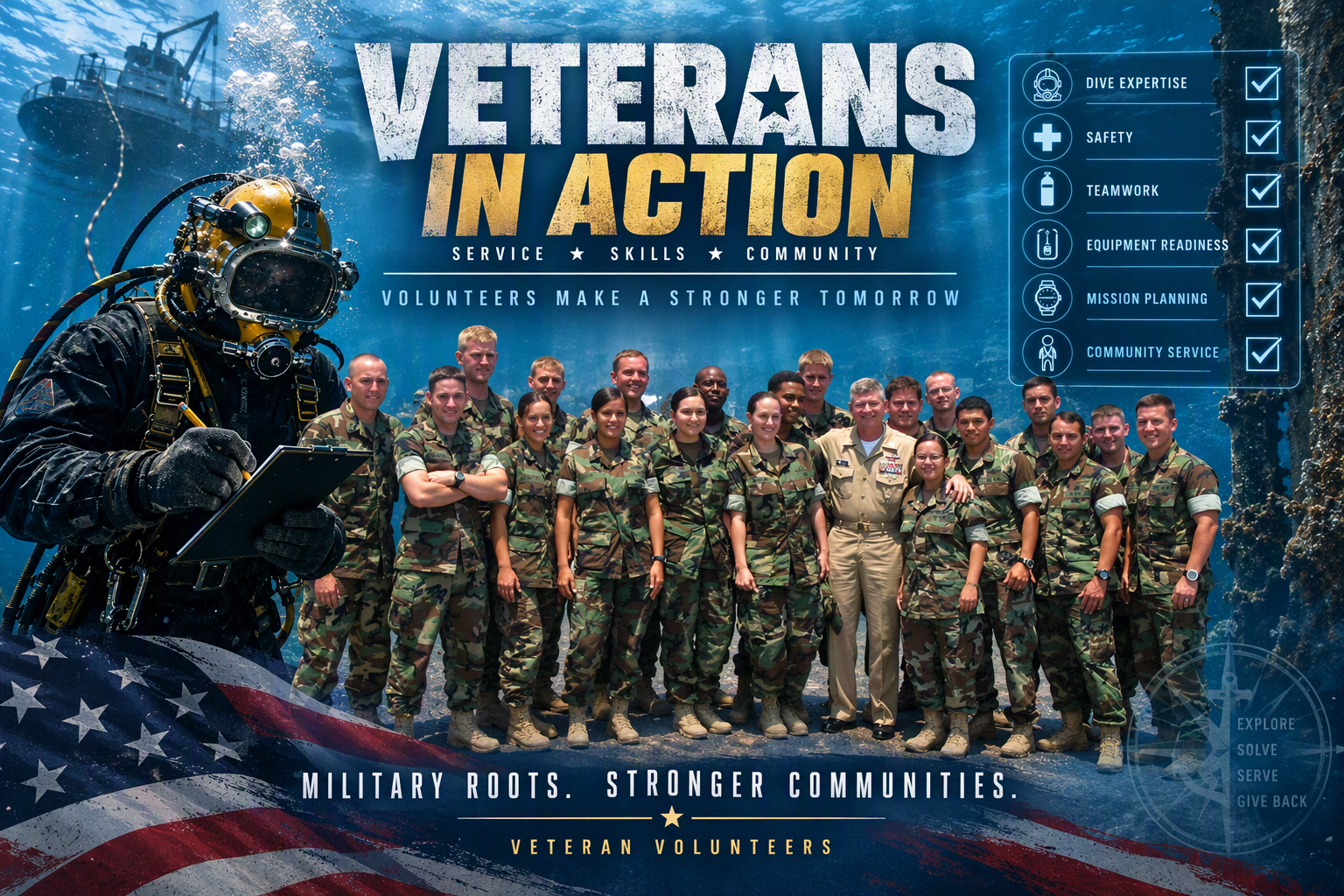
FROM THE ADVENTURES OF A NAVY MASTER DIVER • SERVICE & COMMUNITY •
Why the habits that made you dependable in uniform can make you indispensable in your community.
A Navy Master Diver's Adventure • October 25, 2026
The uniform may be in the closet, but the obligation to serve does not have to end.
Retirement changes the mission, but it does not erase the habits built over a military career. For years, we showed up to work on time. We learned to show up prepared, take responsibility, solve problems with the resources available, and put the team ahead of ourselves. Those habits still have value. The difference is that after active duty, the next mission may be waiting at a veterans' post, a food pantry, a youth program, a hospital, a neighborhood project, or a community board.
The question is no longer simply, 'What job can I do now?' For many retired service members, another question is worth asking: 'Where can I still be useful?' Volunteering provides one answer. It gives us a way to remain connected, contribute hard-earned experience, and keep serving without needing another uniform or paycheck to validate the contribution.
Military service teaches us to recognize that every mission has a purpose larger than the individual. Volunteer organizations operate on the same principle. They exist because a problem needs attention, a neighbor needs help, a veteran needs an advocate, a young person needs a mentor, or a community needs people willing to step forward. The setting is different, but the need for dependable people is familiar.
That is where retired service members can make an immediate difference. We know what it means to accept an assignment and see it through. We understand that the unglamorous work still has to be done. We know that a team succeeds when people communicate, prepare, adapt, and take ownership of the outcome. Those are not merely military traits. They are volunteer-force multipliers.
The most useful parts of a military career are often the traits we stopped noticing because they became routine. Volunteer organizations need many of the same qualities that military teams depend on:
· Reliability - showing up when we say we will and finishing what we accept.
· Mission focus - keeping the organization's purpose in front of personalities, distractions, and setbacks.
· Leadership and followership - knowing when to take charge and when to support someone else's lead.
· Planning and organization - turning a good idea into tasks, timelines, resources, and a completed event.
· Accountability - taking responsibility for results without looking for excuses.
· Adaptability - adjusting calmly when the plan changes, volunteers cancel, supplies run short, or circumstances demand a new approach.
· Teamwork across generations - working with people who have different backgrounds, experience levels, motivations, and communication styles.
· Mentorship - helping newer volunteers grow instead of simply doing every job ourselves.
For some retirees, the easiest first step is an organization whose language and purpose already feel familiar. The American Legion describes volunteer opportunities supporting veterans, military families, and local communities, including VA volunteer service and community programs. The Veterans of Foreign Wars likewise highlights community initiatives and VA volunteer service, with opportunities that support veterans while also reaching into education, civic projects, health, and other community needs.
Organizations like the American Legion and VFW offer something especially valuable to a retired service member: a bridge between the military community we know and the civilian community we now live in. A local post can be more than a place to gather. It can be a base of operations for service - mentoring younger veterans, helping families, supporting VA patients, assisting community projects, organizing public events, or building partnerships with other local groups.
We should not limit ourselves to veteran-specific service. The same work ethic can strengthen food banks, disaster-response groups, schools, youth organizations, Habitat for Humanity projects, civic boards, museums, hospitals, animal shelters, conservation groups, and faith-based or neighborhood programs. The right organization is the one whose cause matters enough to make you show up consistently. Take a look at this unique organization that needs veterans’ assistance: texasrescue.org. [5]
You do not need to be the commander, chairman, or person with the microphone. In fact, one of the most valuable post-military adjustments is learning to serve without rank. Sometimes relevance means leading a project. Sometimes it means stacking chairs, driving a veteran to an appointment, repairing a ramp, mentoring a teenager, managing an event checklist, or quietly making sure everyone else has what they need. Service is still service.
There is an important distinction between bringing military experience into a volunteer organization and expecting the organization to operate like the military. Volunteers cannot be ordered to care. They have to be respected, encouraged, and given a reason to return. Our discipline and standards are strengths, but they work best when paired with patience, humility, and listening.
The retired senior leader who can take direction from a civilian volunteer coordinator, teach without talking down to people, and help without needing credit may be more valuable than the person who reminds everyone what rank they once held. Post-military relevance is not about preserving authority. It is about converting experience into service.
You do not have to recreate the operational tempo of active duty. Pick one cause. Attend one meeting. Volunteer for one project. Ask what work repeatedly goes undone. Then become the person the organization can count on to do that work well. Over time, your experience will reveal where you can contribute more - planning, logistics, mentoring, fundraising support, facilities, safety, communications, training, or leadership.
The goal is not to stay busy simply because retirement feels too quiet. The goal is purposeful contribution. A few dependable hours can matter more than another title.
If you spent twenty or thirty years being needed, retirement can create a silence you did not expect. The phone rings less. The watch bill no longer has your name on it. Nobody is waiting for your decision before the work can continue. That change can make even an accomplished career feel farther away than it really is.
But the community around you still has missions worth accepting. Veterans need advocates. Young people need mentors. Nonprofits need planners, organizers, problem-solvers, and people who keep their word. Local organizations need volunteers who understand that important work is often accomplished long before anyone applauds it.
Your relevance did not end with retirement. It simply moved closer to home. The next mission may not come with orders, a billet, or a uniform. This time, you get to choose it.
Keep serving. Keep learning. Keep showing up. The mission is different, but the need is still there.
References
[1] The American Legion - Volunteering
[2] The American Legion - Volunteer Opportunities
[3] Veterans of Foreign Wars - Local Initiatives
[4] Veterans of Foreign Wars - VA Volunteer Service
[5] T E X A S Rescue Inc, Texas Equine Xperience and Sanctuary
Our Post-Military Career Relevance
